
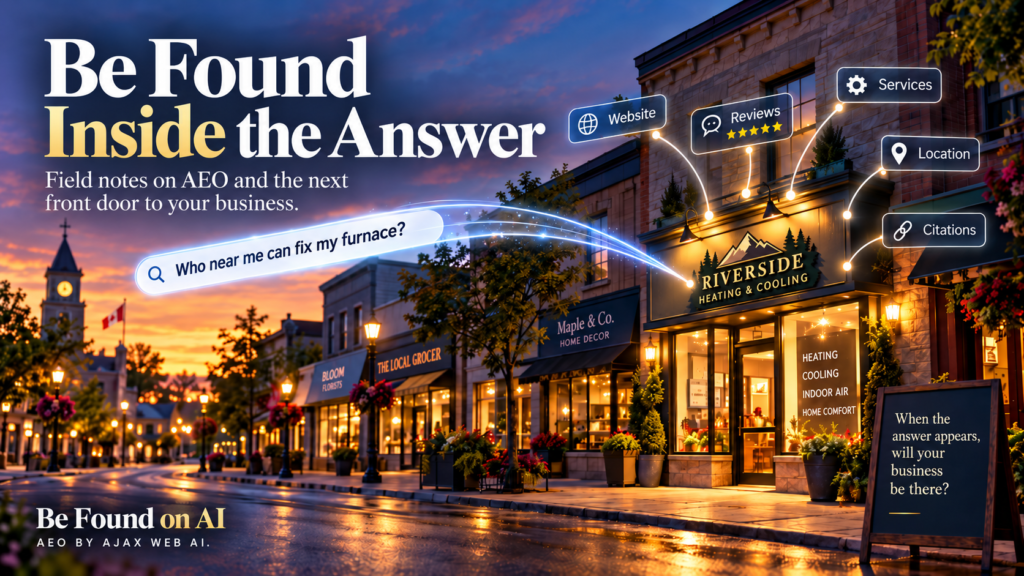
Be Found Inside the Answer
Field notes on AEO and the next front door to your business
Answer Engine Optimization is becoming part of how businesses are found online. For most of the internet’s history, being found online followed a familiar sequence. Someone needed something. They searched. A page of results appeared. Businesses competed for position. The customer clicked.
For twenty years, an enormous marketing industry grew around winning that moment. That model still matters. But something important has moved.
Increasingly, the search result is not a page of links. It is an answer.
Someone asks: Who near me can fix my furnace? Which retirement residences in Durham have memory care? What company should I call for a garage door that will not close?
Instead of ten blue links and an invitation to investigate, the customer may be handed an explanation, a shortlist, a recommendation and the reasons behind it.
The question businesses now need to ask is remarkably simple. Are you inside that answer?
The customer may meet the answer before they meet you
Marketing has traditionally been about earning attention. A sign earns attention. An ad earns attention. A search result earns a click.
AI introduces something different. It can become part of the customer’s decision-making before they reach your website at all. An answer engine gathers information, compares options, describes services, cites sources and surfaces the businesses it considers relevant. The customer may arrive at your website already knowing why they are considering you. Or they may never arrive, because another business appeared in the answer instead.
This is not hypothetical. On June 3, 2026, Google told website owners that AI Overviews had passed 2.5 billion monthly active users and AI Mode had passed one billion, figures first shared at Google I/O in May. Adobe now tracks traffic from conversational AI as its own channel, and its August 2026 report found that AI-referred visitors to U.S. retail sites converted 60% better than other traffic.
The change in search behaviour is already happening inside products people use every day.
This is where AEO enters the picture
AEO stands for Answer Engine Optimization. It does not replace SEO. It adds a second question.
SEO asks: Can a search engine find and rank this business?
AEO asks: Can an AI system understand this business well enough to include it in an answer?
That difference matters. A company can have a beautiful website and strong search visibility while an AI system still misunderstands what it does, where it works or which services it offers.
AI systems assemble their answers from a shifting mix of websites, business profiles, directories, reviews, structured information and third-party sources. Your business is no longer represented by one webpage. It exists as a collection of public signals, and machines are trying to make sense of them.
The new marketing problem is not only attention. It is legibility.
Imagine your business says one thing on its website. Google has slightly different information. An old directory lists a service you stopped offering. A third-party site describes you incorrectly. Your website uses language your customers understand but never clearly states the category an answer engine is trying to establish.
A human being can usually resolve those contradictions. They click around, make an assumption, phone, figure it out. An AI system has to assemble its picture from whatever evidence it can find. If that picture is weak, contradictory or incomplete, shouting louder is not the solution. Becoming clearer is.
That is why we think the next stage of digital visibility is about more than promotion. It is about making a business understandable.
So we start by measuring it
We did not want to sell businesses another vague promise that we could “get them ranked in AI.” There is no honest button that does that. AI platforms change. Their sources change. The same question can produce different answers across platforms or over time.
So we start somewhere less exciting and considerably more useful: measurement.
We ran the first audit on ourselves. If the method could not show us something useful about our own visibility, we had no business selling it to anyone else.
That is what the AEO Visibility Audit is built around. We ask the kinds of questions an actual customer would ask. Not “Tell me about ABC Heating” but “Who near me can repair my furnace?” Then we record what actually happens. Which platform was asked? Was the business present? Which competitors appeared? Was the information accurate? Which sources were cited? Did the system understand the service and the location?
That produces something more useful than an “AI score.” It produces evidence, sorted into four observable states:
Not Mentioned → Mentioned → Cited → Recommended
These are not four levels we can promise to push a business through like a video game. They are four states that describe what AI systems are doing now, and a baseline to measure change against. The full method is described in our methodology.
Being mentioned is not the same as being found well
Seeing your company name in an AI answer feels like success. Sometimes it is. Sometimes it is the beginning of the problem.
The system may mention your business while describing the wrong service. It may misunderstand your service area, rely on old information, or cite a weak third-party source instead of your own website. It may surface you for one wording of a question and skip you entirely for another. Or your business may be absent while a competitor appears again and again.
So the useful question is not “Does ChatGPT know who we are?” It is “What happens when potential customers ask the questions that should lead to us?”
What happens when the answer is wrong?
Then we look underneath it. That is the AEO Complete Audit.
The AEO Visibility Audit tells you what is happening. The AEO Complete Audit investigates why. We compare what AI systems are saying with the public signals they may be relying on: the website, search presence and local signals, business-detail consistency, citations and authoritative third-party sources, structured information where it is useful, content, and the gaps between what the business actually does and what the machines appear to understand.
The purpose is not to manipulate an AI system. It is to remove ambiguity where ambiguity can be removed. To make important facts easier to establish. To strengthen useful sources. To correct contradictions. To build clearer public evidence of who the business is, what it does, where it operates and why it may be relevant to a customer’s question.
This is not the death of SEO
Every new marketing technology arrives with an announcement that everything before it is dead. We do not find that useful.
Google still matters. Websites, reviews, local profiles and useful content still matter. Many of the things that made a business understandable to traditional search also make it understandable to AI. AEO does not throw that work away. It asks what happens after those signals are interpreted by an answer engine.
SEO helped businesses compete for the click. AEO asks what happens when part of the decision occurs before the click. Both can matter at the same time.
The opportunity is unusually close to the surface
Some technological changes require a business to replace equipment, retrain staff or rebuild an operation. This is not one of them.
Much of the raw material already exists: your website, your reputation, your business information, your expertise, your reviews and the things customers repeatedly ask you. The story is already there. The work is making it clear, consistent and well-supported enough that both people and machines can understand it.
The next frontier of marketing is not happening somewhere far away in a laboratory. It is happening in the space between a customer’s question and the answer that appears in their hand.
Before you try to become louder, find out whether you are visible
This is why we built Be Found on AI as a focused part of Ajax Web AI. We establish what is actually happening before recommending what should change.
We do not promise control over AI answers. Nobody responsible should. We measure them, investigate them and look at the evidence behind them. Where a business is hard to find, poorly understood or passed over while competitors appear, we find out what can reasonably be improved.
Because the next customer looking for what you do may not type your company name. They may not know it. They may simply describe their problem and ask AI who can help.
So if you run a local business, try the question yourself. When someone describes the problem you solve and asks AI who can help, are you inside the answer?
That is the question we are trying to measure.
Be found. Check your AI visibility, or talk to Mira at 365-299-3224.
Be Found on AI is operated by Ajax Web AI. We measure how businesses appear across AI-generated answers and investigate the public signals that help AI systems find, understand, cite and recommend them.
Sources: Google, “New opportunities, control and insights for website owners,” June 3, 2026. Google I/O keynote, May 2026. Adobe Digital Insights, AI Traffic Trends Report, August 2026.