
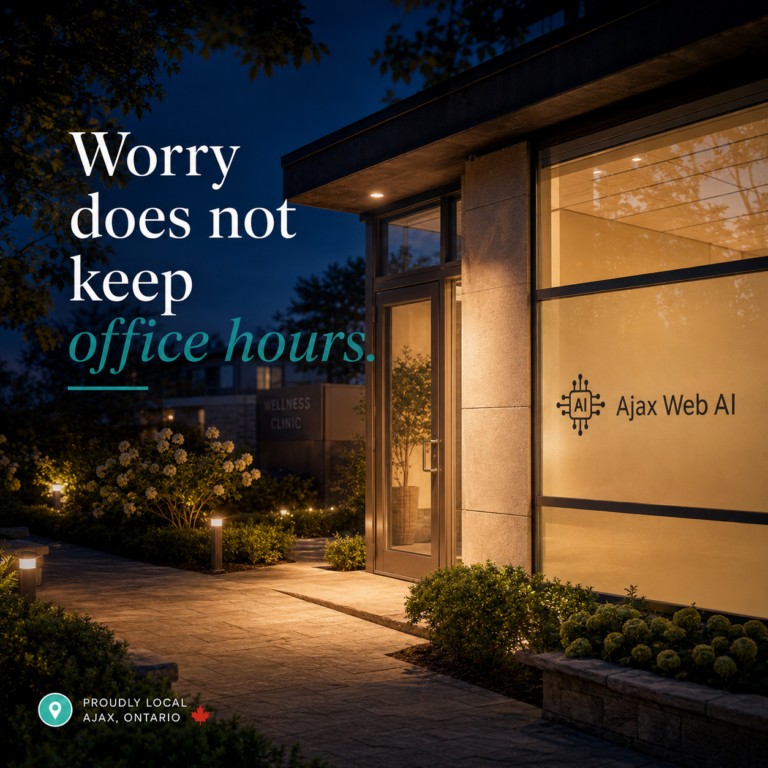
AI in Family Medicine: The Missed Call Report Nobody Runs
Here is a challenge for anyone who runs or manages a family practice in Ontario. This week, pull the missed call report from your phone system. Count one full week. Note how many came in after the doors closed.
Most clinics have never looked. And the managers who do look are rarely prepared for what they find, because at a busy practice the number does not feel like a rounding error. It feels like a second waiting room, invisible, that empties itself into other clinics and walk-ins every single day.
This is not a story about badly run clinics. It is the opposite. The phone loses at good clinics precisely because the front desk is doing the job properly: rooming patients, handling referrals, managing the fax machine that refuses to die, and giving the person at the counter their full attention. Something has to lose, and the phone is the only one that does not have a face.
Now think about who those missed calls are. Patients trying to book. Patients trying to cancel, who will now be recorded as no-shows. Parents calling after work because that is the only time they have. People checking whether a prescription renewal went through. A few of them anxious, calling about something that has worried them for days, finally working up to it at 6 PM and getting a voicemail.
Family medicine has a phone problem, and everyone inside it knows. Here is what responsibly applied AI can and cannot do about it.
What an AI voice agent handles well in family practice
The majority of inbound calls to a family clinic are administrative, repetitive, and answerable, which makes them exactly the right work to automate:
- Booking, rescheduling, and cancellations. Including the evening cancellation that would otherwise become tomorrow’s no-show and a wasted appointment slot someone else needed.
- Recall and preventive care calls. Flu shot clinics, periodic health reviews, the follow-up the doctor asked the patient to book that the patient forgot about by the parking lot.
- Practical questions. Hours, location, what to bring, how prescription renewals work at this clinic, whether the clinic is accepting new patients.
- Accurate message-taking with triage-aware routing. Name, number, reason for calling, urgency level, delivered to the right inbox before the caller has hung up, instead of a voicemail queue the team digs through between patients.
- After-hours coverage with clear direction. The agent tells callers exactly what the clinic’s after-hours protocol is, and for anything urgent it directs them to the appropriate care immediately, whether that is the on-call service, an urgent care clinic, or 911.
Every missed call on that report falls into one of those buckets or gets handed to a human. Nothing falls on the floor.
Where the line is, and in family medicine it is a hard line
No clinical conversations. None. The agent does not assess symptoms, does not tell a patient whether their situation can wait, does not interpret results, does not discuss medications. In a family practice, the temptation to let the technology inch toward triage is real, because triage is where the pressure is. Resist it. Anything clinical routes to a human, and anything that sounds urgent escalates immediately.
It identifies itself, always. A patient calling their family doctor may be at their most vulnerable. An AI that discloses itself and offers a person at any moment respects that. An AI passing as a receptionist does not. We have made the full argument for why AI should always identify itself, and family medicine is the setting that proves the rule.
PHIPA governs all of it. Family physicians and their clinics are health information custodians under Ontario’s Personal Health Information Protection Act. A caller’s identity and reason for calling are personal health information. That means a privacy impact assessment before the agent takes its first call, a written agreement holding the vendor to the clinic’s own obligations, and data minimization throughout. Ontario’s privacy regulator published detailed guidance on AI in health settings in early 2026, and we have broken down how PHIPA applies to AI in plain language for clinic owners.
Patients hear about it from the clinic first. The strongest version of this is a published, plain-language page explaining what the AI does, what it never does, and how to always reach a person. One Ontario clinic set the standard with a patient-facing AI transparency page that answers those questions before patients have to ask. That is not a legal formality. It is the difference between technology that patients trust and technology they tolerate.
The part nobody says out loud
There is a quiet fear in family medicine about tools like this, and it deserves a direct answer. The fear is that automation is one more step toward a healthcare system where patients talk to machines because talking to people costs too much.
Our position is the opposite, and we build to it. The front desk team at a busy family practice is not underworked. They are drowning in exactly the kind of work that keeps them from the human moments the job is supposed to be about: the elderly patient who needs an extra minute at the counter, the parent with a crying toddler who needs kindness more than efficiency, the phone call that genuinely requires a person who knows the patient.
An AI agent that absorbs the routine calls does not remove humans from the clinic. It gives them back to the patients standing in front of them. The measure of success is not fewer staff. It is a front desk that gets to do its actual job.
Run the report
So, back to the challenge. Pull the missed call report. Count a full week. Note the after-hours share.
Once you have seen your number, you cannot unsee it. Every one of those calls was a patient reaching for their clinic and finding nobody there. The technology to answer them exists, and done responsibly, with disclosure, hard clinical boundaries, PHIPA compliance built in from day one, and a human always within reach, it makes the practice more human, not less.
We automate the work, not the relationship. In family medicine, the relationship is the medicine.
Ajax Web AI builds AI voice agents and automation for family practices, clinics, and local businesses across Durham Region and the GTA. Every agent discloses that it is AI, handles zero clinical conversations, and always offers a human handoff. Curious what your missed call number is? Contact us.