
AI in Long-Term Care: Serving Families Without Losing the Human Touch
Long-term care is the hardest test for AI in any industry. Not technically. Emotionally.
When someone calls a long-term care home, they are rarely making a routine call. They are a daughter checking on her mother after a fall. A son navigating admissions for a father who can no longer live alone. A spouse who visits every day and wants to know about this weekend’s family event. These calls carry weight, and any technology that touches them has to be held to a higher standard than a booking line at a salon.
So let us be direct about the question underneath this article: can AI belong in long-term care communication without cheapening it? We believe yes, but only under strict conditions. Here is what responsible AI adoption looks like in an LTC setting, and where the line sits.
The real problem AI solves in LTC
Long-term care homes run on stretched teams. Reception staff juggle in-person visitors, resident needs, physician calls, pharmacy deliveries, and a phone that does not stop. Meanwhile, the calls keep coming outside business hours: families work during the day, and worry does not keep office hours.
The result is a gap nobody intends. Families reach voicemail. Messages sit overnight. A daughter calling at 7 PM about visiting hours gets no answer, and what she hears in that silence is “we are too busy for you.” That is unfair to homes doing their best with the staff they have, but it is what the experience communicates.
This is the gap AI voice agents fill well, because the highest-volume calls in LTC are also the most answerable:
- Visiting hours, parking, and directions
- Tour requests and admissions inquiries
- Event dates and family council meetings
- General questions about services and amenities
- Taking messages accurately and routing them to the right person, flagged by urgency
An AI agent answers these instantly, at 7 PM or 2 AM, in a calm and unhurried voice, and never makes a family member feel like an interruption.
Where the line is
Just as important is what an AI agent in long-term care must never do:
Never discuss a resident’s condition or care. Health information about residents is protected under Ontario’s Personal Health Information Protection Act, and LTC homes are health information custodians under that law. Clinical questions and anything touching a specific resident’s status go to a human, full stop.
Never handle an emergency or a distressed caller. A well-built agent recognizes urgency and distress and escalates immediately to staff or directs the caller to emergency services. It does not try to help. It gets out of the way fast.
Never pretend to be a person. In a setting built on trust between families and care teams, an undisclosed AI is a betrayal waiting to be discovered. Every agent must identify itself as an AI assistant at the start of the call and offer a human handoff at any point. We have written before about why AI should always identify itself. Nowhere does that principle matter more than here.
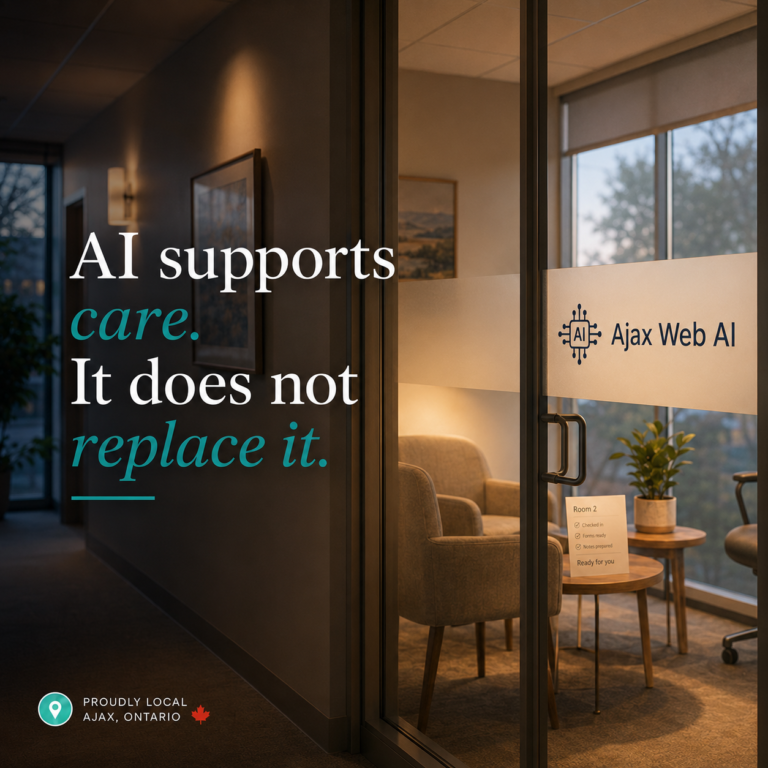
Never replace the relationship. The agent handles the logistics so staff have more time for the conversations that matter. If a home is using AI to reduce human contact with families rather than to protect it, they have misunderstood the assignment.
What families and regulators both need to see
Long-term care sits under more scrutiny than almost any other health setting in Ontario, and rightly so. Adopting AI here means being ready to show your work to three audiences at once: families, staff, and regulators.
The playbook is the same one Ontario’s privacy regulator has laid out for AI in healthcare generally, which we covered in our guide to how PHIPA applies to AI:
- A privacy review completed before the agent takes its first call
- A written agreement holding the technology partner to the same PHIPA obligations the home carries
- Data minimization, meaning the agent collects only what the call requires and nothing more
- Staff who know what the agent does, what it does not do, and how escalation works
- A plain-language explanation for families, published where they can find it, answering what the AI does, what it never does, and how to always reach a person
That last item matters more in LTC than anywhere else. Families are already managing guilt, worry, and hard decisions. A published transparency page tells them, before they ever have to ask, that the technology exists to serve them and that a human is always within reach. One Ontario clinic set the standard for this kind of patient-facing transparency, and the same approach translates directly to long-term care.
What good looks like
Picture the same 7 PM call handled well. The daughter calls after work. The phone answers on the second ring. A warm voice says it is the home’s AI assistant and asks how it can help. She asks about weekend visiting hours and whether the family barbecue is still on Saturday. She gets both answers in under a minute. She asks about her mother’s new medication, and the agent says that is a question for the care team, takes her name and number, and tells her a staff member will call her back in the morning. The message lands in the right inbox, flagged and time-stamped, before she has put her phone down.
Nothing about that interaction diminished the home. The family member got answers instead of voicemail. The care team got an accurate message instead of a missed call. And the next morning, a human being made the call that actually required one.
That is the entire philosophy: automate the work, not the relationship. In long-term care, the relationship is the product. The technology is only welcome if it protects it.
Ajax Web AI builds AI voice agents and automation for long-term care homes, clinics, and local businesses across Durham Region and the GTA. Every agent discloses that it is AI, never discusses resident health information, and always offers a human handoff. Want to hear what it sounds like? Contact us.