
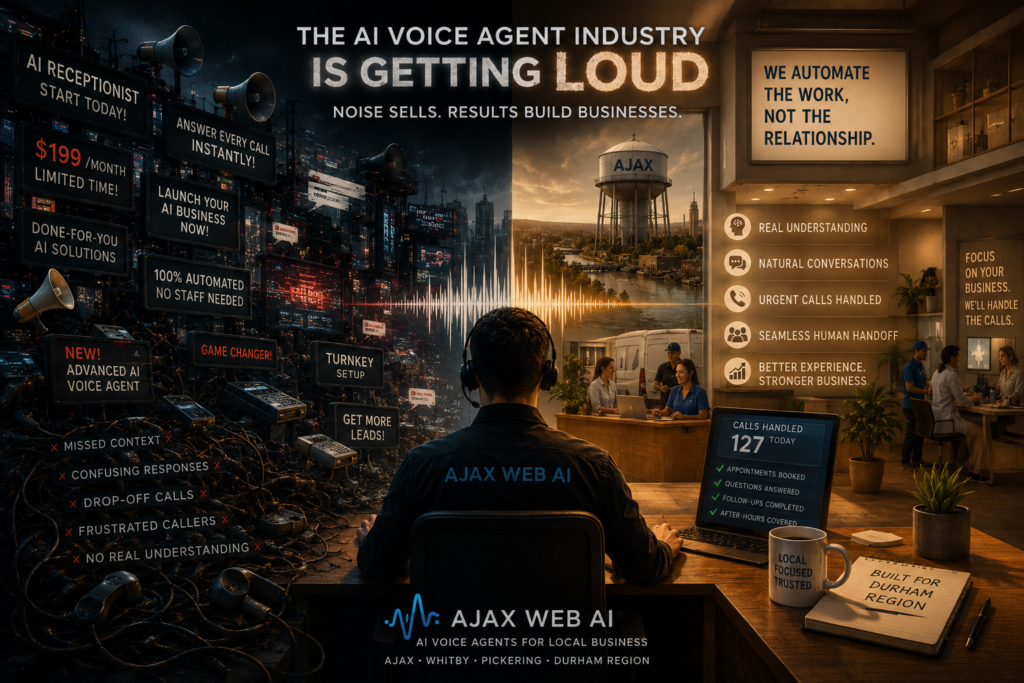
The AI Voice Agent Industry Is Getting Loud
The AI voice agent industry has become noisy lately.
Every social media feed, business group, podcast clip, and LinkedIn post seems filled with promises about AI receptionists that will transform customer service overnight. Some of the technology is genuinely impressive. Some of it is thoughtful and well implemented.
A large amount of it, however, is simply noise.
And for local businesses trying to understand whether AI phone support actually makes sense for their operations, the distinction matters.
Because once you move past the online marketing, many business owners quickly discover there is a significant difference between a polished AI demo and a system designed to function reliably inside a real business environment.
Especially in clinics, trades, service companies, and customer-facing businesses where communication is rarely clean or predictable.
The Industry Is Separating Into Three Layers
One of the more interesting things happening right now is that the AI voice market has quietly divided itself into three different tiers.
Tier 1 — The Flooded Low-End Market
This is the loudest part of the industry online.
Cheap AI receptionists.
Template systems.
White-label agencies.
“Start your own AI business” programs.
Fast outreach.
Low monthly pricing.
Mass-produced automation offers.
A large amount of the visible AI conversation on social media comes from this layer.
Many of these companies are not deeply operational businesses themselves. They are reselling third-party platforms, outsourcing implementation, or learning deployment while actively selling services.
That does not automatically make the technology useless.
But it does create a growing amount of what many people are starting to recognize as AI slop:
systems designed to sound impressive in short demos while struggling once they encounter the unpredictability of real customer communication.
Most real businesses are not operating in controlled demo environments.
Customers interrupt themselves.
People call frustrated.
Someone forgets what they were trying to ask halfway through a sentence.
A caller explains the problem emotionally instead of logically.
An after-hours call suddenly becomes urgent.
That is where operational implementation becomes far more difficult than online marketing.
Tier 2 — Operational AI Companies
This is the layer we believe companies like Ajax Web AI belong in.
The focus here is not simply deploying AI tools.
The focus is operational improvement.
That means understanding:
- missed calls
- overwhelmed front desks
- inconsistent intake
- after-hours communication
- delayed follow-up
- customer frustration
- staff pressure
- workflow breakdowns
The goal is not to “replace humans.”
The goal is to reduce friction while helping businesses communicate more consistently and reliably.
One clinic operator nearby explored implementing an AI receptionist after hours, but quickly realized that the offers being heavily promoted online did not match the complexity, responsibility, and compliance considerations involved in a medical environment.
The technology itself was not necessarily the issue.
The gap was between the sales promise and the operational reality.
That distinction matters.
Because real implementation requires more than connecting software together. It requires understanding how businesses actually function day-to-day.
In our experience, businesses are not looking for futuristic gimmicks.
They are looking for:
- fewer missed opportunities
- calmer operations
- better responsiveness
- support for overwhelmed staff
- more consistency
- systems they can actually rely on
That is a very different conversation from simply selling AI online.
Tier 3 — Enterprise AI Infrastructure
At the top of the market are enterprise-level AI companies serving:
- banks
- telecom providers
- national healthcare systems
- large corporations
- enterprise call centers
These systems involve:
- engineering teams
- proprietary infrastructure
- compliance departments
- advanced integrations
- enterprise analytics
- large-scale operational architecture
Most local businesses will never directly interact with this layer.
But many of the tools and ideas eventually move downward over time into the operational market serving small and medium businesses.
The Real Problem Is Misalignment
A large part of the current AI noise comes from the fact that many people entered the industry because they saw short-term opportunity.
That is understandable.
Every major technology shift creates that kind of movement.
But it also creates misalignment.
Some companies are focused primarily on acquiring customers quickly.
Others are focused on refining systems slowly over time based on real-world usage.
Those are two very different business models.
At Ajax Web AI, our position has always been that businesses should genuinely be better off after implementation than they were before.
That sounds obvious.
But in practice, it changes how systems are designed.
It changes:
- intake flows
- escalation handling
- after-hours logic
- call summaries
- workflow integration
- customer communication
- support expectations
It also changes how success is measured.
The goal is not simply:
“Did the AI answer the phone?”
The real question is:
“Did the business function better because the system existed?
The Difference Between AI Demos and Operational Systems
Many AI voice demos today are genuinely impressive.
For 60 to 90 seconds.
But operational environments are messy.
A real receptionist role involves:
- interruptions
- emotional conversations
- unclear explanations
- scheduling conflicts
- urgency
- nuance
- context
- edge cases
Businesses quickly discover that reliability matters far more than novelty.
This is especially true in healthcare, trades, customer service, and appointment-based businesses where communication quality directly affects trust.
One of the biggest misconceptions in the current AI market is that implementation is mostly technical.
In reality, much of the work is operational and human.
It involves understanding:
- how businesses communicate
- where workflows break down
- how customers behave under stress
- what information actually matters
- when AI should assist
- and when a human should step in
That is not something most social media demos reveal.
Building Systems That Businesses Can Actually Use
The loudest companies online are not always the ones most experienced with real operational environments.
Social media rewards attention.
Operations reward reliability.
Those are not always the same thing.
And importantly, most of the online AI noise is not coming from deeply rooted companies competing locally in Durham Region.
Much of it exists inside online marketing ecosystems disconnected from the realities of serving local businesses face-to-face over time.
Building trust with local businesses is slower than building attention online.
But it is also more real.
It requires:
- accountability
- implementation support
- refinement
- observation
- patience
- operational understanding
That is the layer we believe matters long term.
Because businesses do not need more noise.
They need systems they can rely on.
We automate the work, not the relationship.